Ugly Is the New Organic: Why Wonky Vegetables Are the Plant-Based Cook's Best-Kept Secret
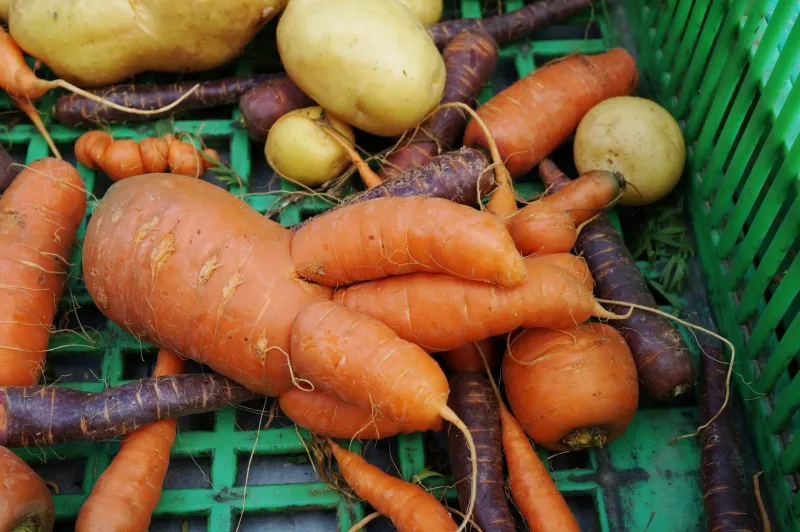
Photo: imperfect misshapen vegetables colorful farmers market, via images.theconversation.com
There's a carrot sitting in a packing shed in California's Central Valley right now that will never see the inside of a grocery store. It's forked — two stubby legs splaying outward like it's doing a dramatic splits — and according to the cosmetic standards that govern American retail produce, it's trash. It tastes exactly like every other carrot in that field. Maybe better. And it's almost certainly headed for a landfill.
This is the ugly produce paradox: an estimated 20 billion pounds of perfectly edible fruits and vegetables are discarded in the United States every year because they fail to meet appearance standards that have nothing to do with flavor, nutrition, or food safety. For plant-based eaters — people who've already made peace with the idea that a meal doesn't need to look like a Norman Rockwell painting to be transcendent — this represents both a moral outrage and an extraordinary opportunity.
The Beauty Myth, Vegetable Edition
America's obsession with cosmetically perfect produce didn't happen by accident. Post-World War II industrialization standardized grocery supply chains in ways that prioritized uniformity above all else — because uniform produce stacks more efficiently, ships more predictably, and photographs beautifully in a circular. Consumers were gradually trained to associate physical perfection with quality, a conflation that has essentially no scientific basis but enormous economic consequences.
"The flavor compounds in a vegetable have absolutely nothing to do with its shape," says Dr. Maria Chen, a food systems researcher at UC Davis who studies produce waste. "A heirloom tomato that cracks at the shoulder during a rain event isn't compromised. It's just wet. The sugars, the acids, the volatile aromatics — all still there. All still delicious."
Farmers have known this forever. Ask anyone who grows food what they eat for lunch during harvest season, and the answer is almost always the stuff that doesn't make the cut. The knobby peppers. The twin-fused beets. The oversized zucchini that escaped notice for two days and is now roughly the size of a small submarine. These are the vegetables that farm workers eat, that chefs with farmer relationships quietly procure, and that the rest of us rarely encounter.
The Plant-Based Kitchen Is Perfectly Positioned for This
Here's where it gets interesting for the Dead Beet Eats crowd: plant-based cooking is, structurally speaking, almost uniquely suited to benefit from ugly produce. Why? Because so many plant-based techniques — roasting, braising, blending, fermenting, pureeing — actively dissolve the cosmetic differences that made the vegetable unsellable in the first place.
That cracked tomato becomes a breathtaking marinara. The forked carrot roasts exactly the same as its symmetrical sibling, caramelizing at the edges until it's practically candy. The oversized zucchini, too watery for a quick sauté, is ideal for slow-roasting with herbs until the excess moisture evaporates and the flavor concentrates into something genuinely extraordinary.
Chef Devon Okafor, who runs a plant-forward catering operation in Atlanta, has built his entire sourcing model around cosmetically rejected produce. "I get calls from farms that can't move product because a hailstorm hit and everything's got little divots in it," he says. "I show up with a truck. My clients eat some of the best vegetables in Georgia and they pay significantly less for them. Nobody's complaining about the divots."
Where to Find Your Beautiful Rejects
The ugly produce ecosystem has expanded considerably in recent years, giving home cooks more options than ever:
CSA boxes and farm-direct subscriptions are the original ugly produce delivery system. Many farms offer a discounted "seconds" tier specifically for cosmetically imperfect items. Ask your local CSA if this option exists — many don't advertise it but will happily accommodate the request.
Imperfect Foods and Misfits Market have built entire business models around rescued produce, delivering boxes of cosmetically challenged (but perfectly edible) fruits and vegetables directly to your door. Both services have expanded significantly across the US and offer good value for plant-based households that go through a lot of produce.
Farmers markets, end of day — show up in the last 30 minutes of a Saturday farmers market and you'll find vendors actively trying to move inventory. Ugly produce goes first because the vendors know it won't survive another week. Bring cash and be ready to negotiate.
Restaurant supply distributors sometimes sell direct to serious home cooks, and their standards for produce are often purely functional rather than cosmetic. It's worth calling your local restaurant supply house to ask about consumer purchasing options.
Cooking the Rejects: A Few Ground Rules
Ugly produce does occasionally require a little more attention than its perfect counterparts, mostly in the prep stage. A few principles worth keeping in mind:
Assess, don't assume. A blemished exterior doesn't automatically mean a compromised interior. Cut into it. If the flesh looks and smells normal, it is normal. Soft spots that are purely surface-level can usually be trimmed away without affecting the rest of the vegetable.
Match the technique to the condition. Produce that's slightly past its visual prime often has reduced moisture and more concentrated flavor — which makes it ideal for applications where you want intensity. Roasting, slow-cooking, and blending are your friends. A slightly wrinkled bell pepper is not great for a raw crudité platter; it's phenomenal in a romesco sauce.
Use it fast. Ugly produce has often already been sitting longer than retail produce — it was rejected, stored, and then redistributed. Plan to use it within a few days of receiving it rather than letting it languish in your crisper drawer.
Embrace the whole thing. Ugly produce culture pairs naturally with root-to-stem cooking. That giant, slightly-past-peak zucchini? Use the flesh for a gratin, the skin for chips, the seeds (if they've developed) toasted with olive oil and salt.
The Bigger Picture
There's a political dimension to ugly produce that's hard to ignore. The cosmetic standards that discard 20 billion pounds of food annually are maintained largely by major grocery chains whose consumer research suggests shoppers will reach for the prettier item. That research, in turn, reflects decades of conditioning rather than any inherent preference. It's a self-reinforcing system that wastes staggering quantities of food, consumes the water and labor that went into growing it, and contributes meaningfully to methane emissions when that food rots in landfills.
Choosing ugly produce is, in a small but real way, a vote against that system. For plant-based eaters who are already making food choices with one eye on environmental impact, it's a natural extension of a philosophy already in practice.
The wonky carrot doesn't care that it's not symmetrical. It just wants to be eaten. And honestly? After you've roasted it with miso butter and thyme until it's collapsing and caramelized and deeply, profoundly good, you won't care either.
The ugly produce revolution isn't coming. It's already here, one forked carrot at a time.